
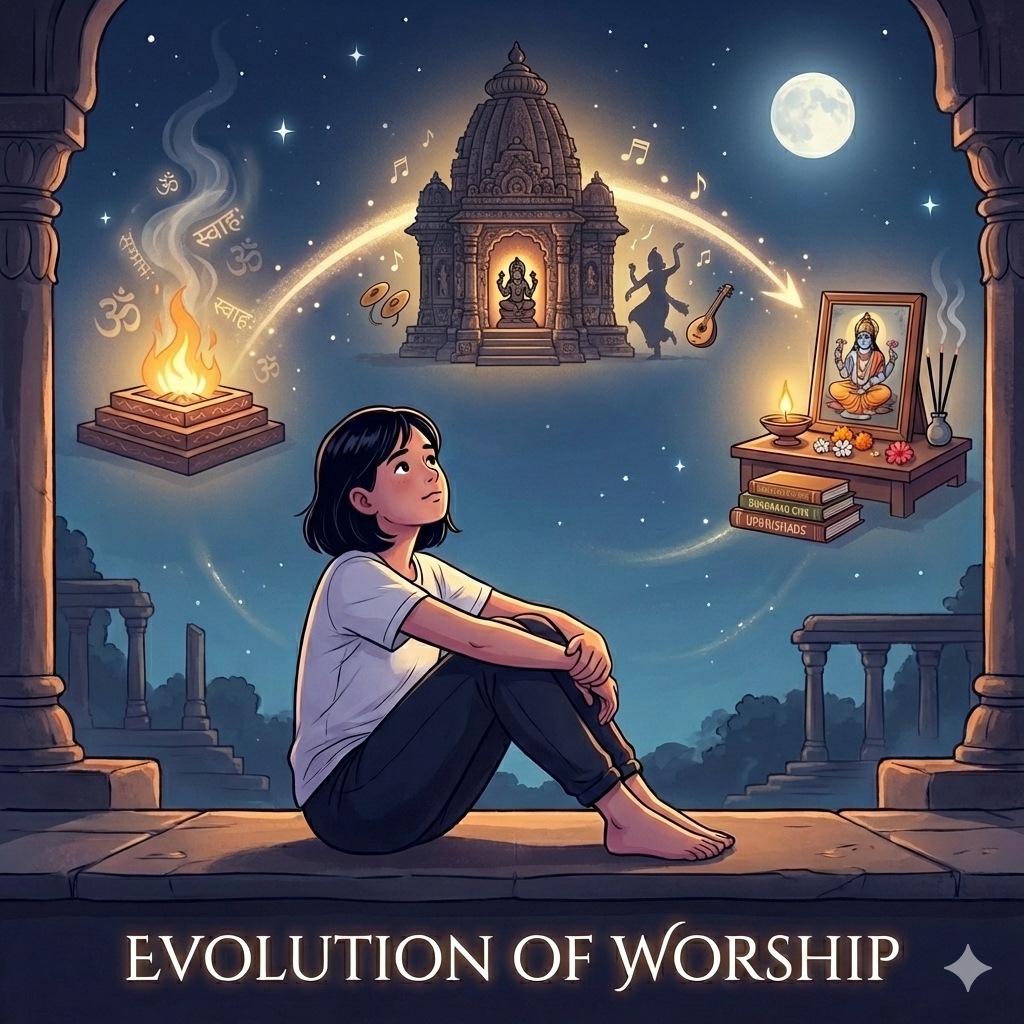
Spirituality came first. Organised religion came much later and took over many aspects of the spiritual journey. We spoke about that and about whether it helped or hampered one’s quest in an earlier post here.
In this post, the idea is to explore how worship evolved and whether this evolution has helped in the quality of our contemplation. While worship must have begun from when we were all pagans, since there’s not much reference material from that period, for the purpose of this post, we will begin from the pre-vedic period, but we have no written texts from that period either. So we have to infer their form of worship based on later texts and the overall pattern, and move into the vedic period.
Rig Veda 10.136 describes our munis (ascetics) as having achieved spiritual powers through independent practice (Tapas) rather than through organised ritual. They are said to have achieved certain siddhis (powers) based on practices they discovered for themselves.
Rig Veda 1.1.1 says that Agni is the priest (mediator) between the performer of the yagna and God, and that there was no one else needed.
Those who wanted powers used the fire as a medium or performed penances of their own independent creation, and worshipped the God of their choice. Those who wanted to know the truth would sit in meditation and focus on questions like ‘what is real’, ‘who am I’, ‘where am I headed’ and so on.
The key learning from that period was that there was no ‘priesthood’. Just the doer and the deed, with fire as the medium sometimes. The doer would speak his own prayers, and he would experience the sacred directly.
Some of these ascetics became gurus and would impart their learnings to disciples one-on-one, over a period of time, some of which got established as paths.
As societies grew, this personal transmission of knowledge couldn’t scale. So to aid people in their spiritual practice, it was felt that some rules should be put up, and thus priesthood was born. Starting from about 800 BCE, there is proof of codified religion and practices in our texts. The major inflexion point of this codification seems to have been in the Manu Smriti, which probably was compiled around 200 BCE. Like with the Vedas, Manu Smriti also was most likely compiled by multiple people, going by the differences in tone and examples. It was completed by around 200 CE. Manu Smriti made priesthood almost essential. It made brahmins as gatekeepers to most rituals. So, from being able to interface with God directly, people were taught that you needed a priest to access the divine. The text felt that humans needed order, and that spirituality without structure would become chaotic. I seriously doubt the wisdom of some of that text, but that could be in hindsight. Still, it is a fact that we made worship extremely complicated this way, and added in a third party who brought his own ‘intelligence’ into the mix, the effects of which we are still living with to this day.
This Agamic takeover was complete by about 600 CE. Prana Pratishta into an idol was a revolutionary idea, and the position of priests in society was further solidified since the Agama science made them central to this whole process. The Narada Pancharatra says that ‘the deity resides everywhere, but for the benefit of those who cannot meditate on the formless, we create a form and establish the Lord in it‘. The idea was that fire would vanish once the ritual ends, but that stone was permanent, and hence stone is a better ‘container’ for the divine. Basically, our ancestors thought they made the process ‘easier’.
From being people who could hold on to the abstract, we became a people who needed a visible anchor. The quest was for emotional intimacy in the form of a statue that we could wash, feed, dress, and touch – factors which they thought fire could not provide.
And in this process, caste system was born, a hierarchy was established, and the effects of that go way beyond the spiritual quest for which they were originally conceived.
Historical evidence shows that the Gupta period – 320-550 CE – had physical temples already. So they must have been there even before that, and we can see that by about 500 CE, the move from individual practice to a temple-centric idol-based form of worship was complete.
We spoke about the Bhakti tradition in an earlier post – Is God Real. It is a fascinating movement, and sometime later, will get to a full post exploring how it evolved and shaped our societies. Bhakti tradition started almost parallelly, from the 6th century CE, as this change in worship was solidified. People who wanted a direct interface with God resisted the medium and found their own expression. Around the same time, in South India, Alvars and Nayanars forged their own path. The Divya Prabandham (4000 verses of devotional poetry) was composed in Tamil, breaking away from the tradition of Sanskrit verses. All these paths converged in the thought that we don’t need a priest and all we needed was our own heart, to worship God.
Andal’s Tiruppavai (7th century CE) is today treated as a sacred scripture. Nowhere does it make any mention of a priest, about rituals, or about caste. All it talks about is love for Krishna.
Kabir (15th century CE) taught that the name of God is available to everyone, and since by then Islam had established itself in India, he added religion also to the list that he disowned. So no need of rituals, no priests, no caste, no religion, just pure consciousness. Tulsidas wrote Ramcharitamanas in the local language, making the Ramayana accessible to the masses. By then, our epics were already available in local languages.
Our texts are so diverse that we can actually infer anything from them depending on the prism we look at them through. From the same text, opposing statements could be extracted, depending on the person proposing the idea and their bias. In translations, many changes took place. Entire character arcs were changed / deleted / added and so on. For example, there is no mention of the Lakshmana Rekha in Valmiki Ramayan. This seems to have made its was into the epic in the Telugu and Bengali re-writings of the epic in the 14th / 15th century, and got mainstreamed when Tulsidas also made it a part of his popular retelling of the Ramayana. Today, all these different Ramayanas have gelled and a modified popular epic has taken centerstage. And people from different regions got caught up in the nitty-gritties of our mythology, fighting about which was correct, and lost track of the broader picture – which was the simple quest for truth we started from all those thousands of years ago.
Many argue that the institutionalisation of religion was essential and without the agamic model, it would probably have not survived or scaled in the face of violent religious invasions. I think they are correct. The system may be flawed, but it certainly worked.
In the 19th and 20th centuries, however, there have been many ashrams and schools of thought which led us to think beyond rituals, and go back to the original quest for truth, this time aided by elements from the different branches – including temple culture and the Bhakti movement. Meditation and contemplation have once again become a major part of their spiritual practices, and many who have been initiated into that idea continued it at home – like our ancestors originally practiced. As more people gain this independence and grow intellectually, we are seeing the conditions that could enable a return to the original quest for truth. Whether this cycle will complete, or get re-institutionalised yet again, is the question our generation must answer 🙏🏼
You can follow this blog either through my Twitter (X) account at x.com/simplespirit1 or if you prefer email notifications for new posts, by signing up using the form below.