
Wanting to know who / where God is is a simple enough question, that most people have quite early in their lives. Our childhood stories show God as a person who will come and solve our problems, provided we are devout enough or do a lot of hard penance for a specific purpose. And then, as the years went by, I heard Baba’s bhajans like ‘Atma Rama Ananda Rama’ which said that Rama (or God) was within our Atma. Later, I started learning Vedic chanting, and this theme became even more pronounced.
In the Svetasvatara Upanishad 5.8, it is said –
Angushta-matrah purusah jyotir-avyayah | Angustha-matra tapaso ’tha hridaye tishthati, meaning The Person, the size of a thumb, shines like a flame without smoke. He is the Lord of the past and the future. He is the same today and tomorrow. This is That.
Katha Upanishad also has a similar phrase, and the next blog post is exclusively about Katha Upanishad, so we will cover it then. Our Guru who taught us Vedam spent some time explaining this concept and it stayed with me visually. A little thumb-sized God is a deliberate symbology, easy to understand and visualise. To show that God isn’t invisible, but that it is a physical presence within us. Makes it easier for us to understand and respect ourselves! Placing that figure in our heart clearly shows that we don’t need to search outside of ourselves. And while being that small, it is also said that He is infinite and eternal. Just understanding that concept took a very long time, and while reading up about it, I realise that this is not unique only to Hinduism.
Other religions are even more pronounced in this explanation. Quran 50.16 says
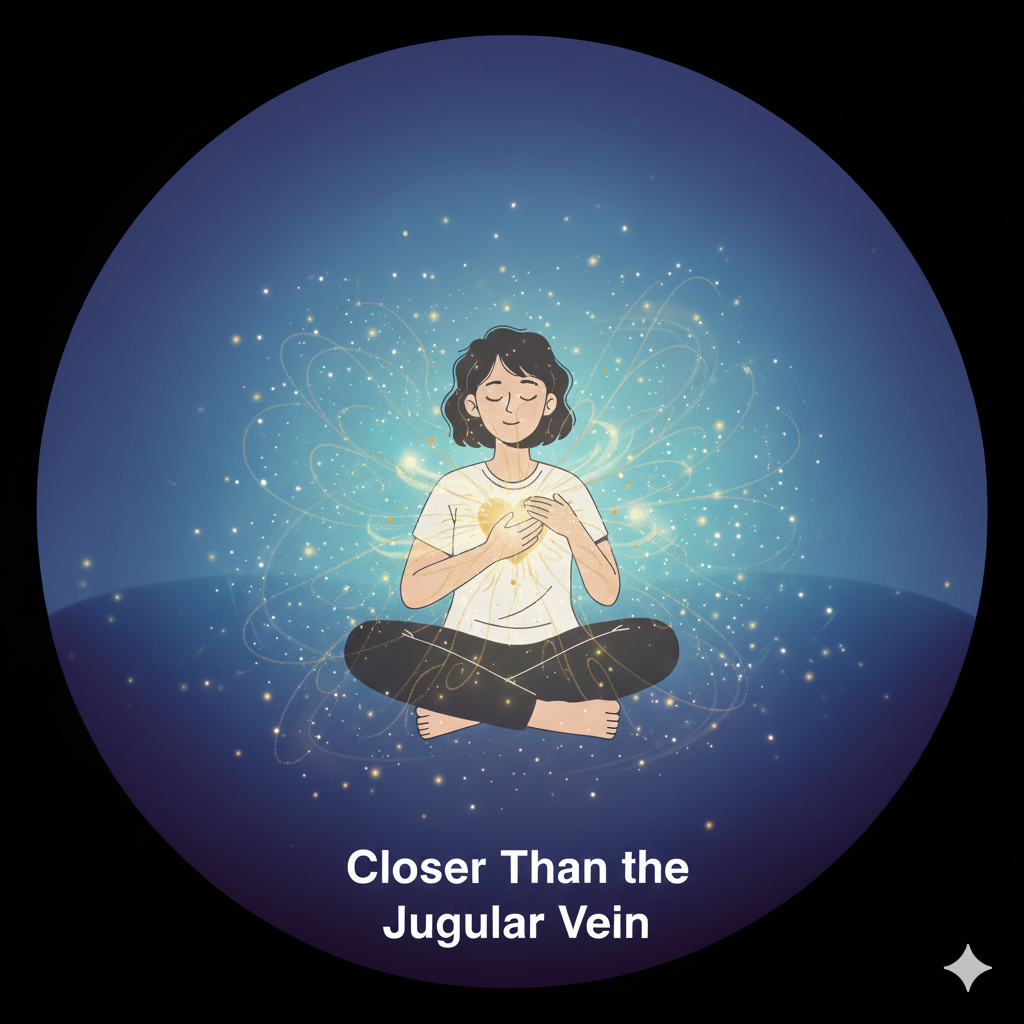
wa nahnu aqrabu ilayhi min hablil warid, which means ‘We are nearer to him than his Jugular Vein’. That’s God speaking. So he says He is nearer to us than our jugular vein – a clear visualisation which picked one of the most important veins of the body, carrying blood from our heart to our brain, and saying that He is closer to us than even that vein. I love the phrasing of this quote, and hence that’s the title of this post 🙂
Jesus, speaking in John 14:20 says ‘I am in my Father, and you in me, and I in you’. This is quite clear and needs no translations. There are many more references to be found in the Bible, like Acts 17:28, and many more. It says everytime that He is in us and we are in Him.
Zen Buddhism has a rather unforgettable quote. It is said that ‘If you meet Buddha on the road, kill him’! Basically telling us that the Buddha we meet on the road is not the real Buddha, and the real Buddha is inside of us and we don’t need to search for Him anywhere else! Beautiful. All kinds of Buddhism have many examples and phrases directly spoken by the Buddha which clearly tell us that searching outside for God is a waste of time. It seems to be one of the tenets of the religion itself. The more I read about it, the more I find Buddhism fascinating; and we will undoubtedly visit this more in the coming posts.
There are many such examples from other religions like Jainism, Sufism etc too. So if we go back to the source, all religions start from the point that God is within us, some say we are God himself, there is a beautiful quote from Swami Chinmayananda that we are not human beings undergoing a spiritual experience but divine beings undergoing a human experience. What is even more wonderful is that these traditions all developed independently in different parts of the world at different times. And yet they all start from this same fundamental point of view. There has to be some truth in it!
So, it is obvious that the practice of spirituality was to be internal. Somehow, after organised religion was formed, we externalised most practices. This dichotomy is the foundation of all my confusion. While religion uses these same scriptures and tells us that Sadhana is supposed to be internal, the practices we often follow go in the opposite direction. While the Quran directly states it, scholars over the years have de-emphasised this and moved to a set of practices more in favour of law and obedience. Christianity started from this point, but then moved to a philosophy that God is a distant external being who is judging us for our actions. Hindu orthodoxy turned this direct experience into an abstraction. Buddhist scholars turned a simple truth into a complicated religion.
Codification of this simple truth – Spirituality – was put forth in the form of a container – Religion – originally thought to help us understand it easily. But with time and with constant thickening of the walls, these containers became prisons, and for many, have defeated the original purpose. I love how Kandukuri Sivananda Murthy garu puts forth how simple achieving God is. We were in Warangal for his 80th birthday, and he spoke his heart that night about how we complicate this journey. He gives an example about how we build a big building, beautify it with plants and creepers, fill the home with beautiful furnishings, sit inside an air conditioned room, and then find it difficult to see the Sun. He says the Sun is equally available for everyone, but we made it tougher to see him when we want to. The more walls we build, the more effort we have to put. Guruji’s explanations and examples are unparalleled!! If you understand Telugu, here is the full speech – 35 mins – absolute masterclass!
There is a word that constantly comes up – Sadhana. The simplest way of explaining this term is probably to remind us of this truth – that what really matters is already within us, and anything that takes us away from it is a practice that is to be shunned. Spiritual quest is an extremely practical journey which is meant to make us better in every sphere of life, and beyond.
I bookmarked some interesting texts while studying for today’s topic, and the one immediately piqued my interest is Katha Upanishad and Nachiketa’s story. So started reading that and finding sources, that’ll be our next post.
Bibliography –
Svetasvatara Upanishad 5.8
Quran 50.16
Bible – John 14:20
The record of Linji – Discourse 19
You can follow this blog either through my Twitter (X) account at x.com/simplespirit1 or if you prefer email notifications for new posts, by signing up using the form below.