
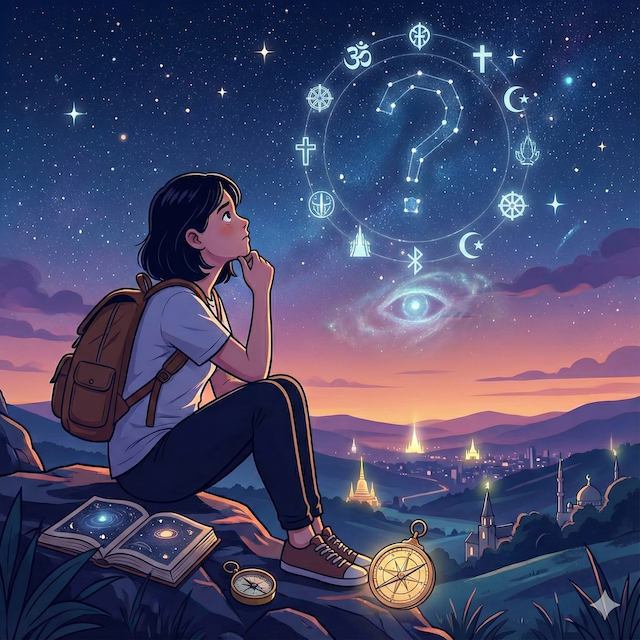
One of the most persistent questions since humans started thinking about religion and spirituality is this – whether God is real.
Often, the question itself is considered as heretic. But if the path to our spirituality lies via religion, there is no progress till this question is resolved. Atleast ‘resolved’ to one’s satisfaction and an internal coming-to-terms. Asking this question is extremely important and critical to spiritual evolution.
While reading about how religion came about, there are two approaches that I found. Commonly called the ‘bottom-up’ and ‘top-down’ schools of thought.
The bottom-up approach views God as the interface and is subscribed to by those who are anthropological / evolutionary in their search. The idea was that there is something infinite and powerful beyond our physical world – which could be experienced through nature in the form of storms and cyclones. It was natural to respect that infinite power, but the mind couldn’t comprehend it enough to assign it an identity. So they called it Zeus or Indra or by other names. By making that power into a human-like-being, we could negotiate with it, ask it for what we want, and in general, have a conversation with it. So God here became the UI (user interface) for the universe, where the cause was explored through the effect!
The top-down approach is more from the mystical view that our rishis and prophets expressed. They felt there is a fundamental consciousness that underpins reality. When the mind was quiet, they could feel the presence of that consciousness. Those who experienced it first hand used phrases like ‘infinite love’ or ‘boundless light’ to describe it. Like we spoke in our previous posts, they found that same infinite bliss within themselves too – as a small light / deity form in our heart. So from that light came the form of God and religion was built around that philosophy. In other words, the cause was explored first and then its effect was the universe.
While the first approach considered God as a king welding power over us, the second considered us as part of that divine experience. Either way, what started as a quest to understand this power / consciousness / presence, became codified as religion, and for either of these schools of thought, what is true is that many of us started worshipping the concept while (mostly) ignoring the underlying code.
I found an interesting synthesis of both these paths. A convergence point in the form of Bhakti / devotion. In Bhakti, that interface meets the reality. The solution was to take the infinite consciousness and pour it into an interface that we could identify – by means of assigning them a human-like form. That gave us living Gods. It made it easier to quantify the infinite. He came with a face that we could recognise and love. Hence the images of white Jesus, black Jesus, brown Jesus etc. The reality that accompanied this form was that though we could see a physical form, a ‘viswaroopam’ was the reality, where this form actually grew to infinite proportions and was all-pervading. But the form limited our thinking because of its physical properties, and for many, it still is a stumbling block to comprehend the supreme reality which came much before the limiting form did. God (or whatever we would like to call that higher power) is the light and not the lamp.
In Bhakti, we start by worshipping a ‘person’ – either Rama or Allah or Jesus. Bottom-up, we initially treat them as separate, for ease of identification in our minds. As our love for that form increases, our ego melts and the ‘me’ who is worshipping starts to dissolve into the ‘Him’ who is being worshipped. And then the interface breaks open! Like Hanuman – the epitome of Bhakti in Hindu literature – realises, ‘I thought I was serving Rama, but Rama is in me!’. Sufi saints realised that they were loving God, but they are that love, and they find bliss in that realisation.
The interface was the doorway, the reality is the destination.
In my earlier post about Kathopanishad, I mentioned going down the duality rabbit hole and that an upcoming post is about Dvaita and Advaita philosophies. While reading about how those came about, I was struck by how Shankara, who expounded that the worshipper and the worshipped are the same, still composed hymns about Krishna and Shiva and made it appear like we were separate from them. Now I think I understand this better. Shankara must have understood the utility of this interface better than anyone else, and must have realised that this ‘externalisation’ would be the easiest way for us to make a connection with the infinite. But while it gave us an easy way to worship the supreme, it also threw a truckload of spanners into the works by getting us caught in the quagmire of nitty-gritties which accompanied personification of a deity.
So, answering the first question we posed ourselves, I think yes, God is real. Not necessarily in the form we ascribe to Him, but more in a formless and supreme way. But then, the infinite can take any shape and form, and that would mean the limits we set by our imagination also is as real as it gets. The form should only be a starting point (if needed) and we should have the wherewithal to progress beyond. Most don’t, because our entire syllabus revolves only around the frontend, the interface. It may be ok for most people, but for the inquisitive, this does not fully satiate their inquiry.
Ramakrishna Paramahamsa, one of the most recognised masters of recent times, treated Goddess Kaali as a living person and spoke to her everyday through her statue. After a while, his guru Totapuri is said to have told Ramakrishna that he would need to ‘smash the image he carried of the Mother’ if he was to progress beyond. Ramakrishna couldn’t do it as he loved the form too much. So his guru gave him a solution – to imagine a ‘sword of discrimination’ to cut through the image he carried of Kaali, and only after using that, Ramakrishna was said to have attained Nirvikalpa Samadhi.
I quite enjoyed reading about how our scriptures and masters from all religions approached this extremely delicate subject. And from here, we can cross the bridge to Dvaita and Advaita in the next post 🙂
Bibliography –
Sri Ramakrishna, the great master – Swami Saradananda
The Bhagavad Gita – Chapter 12, Verse 5; Chapter 12, Verse 6-7
Complete works of Swami Vivekananda – Vol 3 – Bhakti Yoga – Pratika worship
Rumi – Ishq-e-Majazi and Ishq-e-Haqiqi
You can follow this blog either through my Twitter (X) account at x.com/simplespirit1 or if you prefer email notifications for new posts, by signing up using the form below.